
Antenna Length Calculator

Using the calculator

One length of wire, two ways to feed it

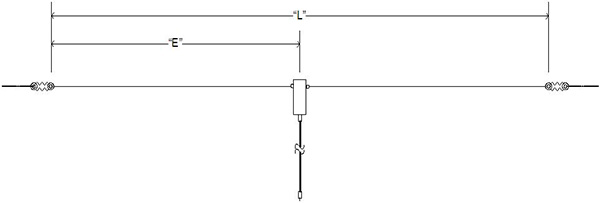
A half-wave dipole and an end-fed half wave are the same piece of wire. The only real difference is where the feedline attaches — the dipole gets coax in the middle, the end-fed gets a 49:1 unun at one end. That is why a single calculator handles both, and why the total length it gives you does not change when you switch tabs.

Type a frequency, get a length

Put in the frequency you want to work, or pick a band and a license class and let the tool pick the frequency for you. It comes back with the total length of wire, the length of each leg for a dipole, and the same numbers again in metres — plus the actual formula it used, so nothing is hidden behind a black box.

Every answer is worked out twice, once in feet and once in metres, from the same physical constant. They are not two different tables that might disagree. They are the same equation printed two ways.
dipole antenna diagram

If you have never built an antenna before, start with the dipole tab. It is the most forgiving wire antenna there is, it needs no matching transformer, and if you can get the middle of it up in the air and the two ends out sideways, it will get you on the air. The end-fed is the one to build when you only have one good high support and you want several bands out of one run of wire.

Why this one is different

Three things most antenna calculators leave out

There are dozens of half-wave calculators online and most of them do the same one thing: divide 468 by your frequency and stop. That is the easy part. These are the parts that actually decide whether the antenna works when you hang it up.

It knows what you are allowed to use

Cutting for the middle of the band puts your antenna's best behaviour in a segment a Technician or General may not be able to transmit in. Pick your license class and it centres the antenna on the piece of the band you actually hold.

It tells you what to cut after you measure

Hook up an analyzer, read the SWR at three frequencies, and type them in. The tool works out where the antenna is really resonant and tells you how much wire to add or take off — and which end of the mistake you are on.

It checks whether it fits your yard

Give it the distance you have between supports and it will tell you what bands fit flat, and how far the ends need to droop as an inverted V to make a longer band fit in the same space.

Reading your analyzer

You hung it up, you swept it, and the dip is in the wrong place

This is where most people get stuck, and it is the part the other calculators do not help with at all. You are not holding a resonant frequency — you are holding a screen with a curve on it. The question is what that curve means for the tape measure.

Read the SWR at three frequencies across the band, low, middle and high, and type the three pairs into the trim tab. The tool fits a curve through your readings, finds the bottom of the dip even if the dip is off the edge of what you swept, and turns that into inches.

It also tells you which direction you are wrong in, in plain words. If the dip is above where you want it, the wire is too short and you need to add. If the dip is below where you want it, the wire is too long and you can cut. Getting that backwards costs you a whole antenna, because you cannot uncut wire.

rig expert antenna tuner

One more thing worth knowing: when the SWR will not come down anywhere, the problem is usually not the length. Check the connections at the centre insulator, check the coax, check that the unun is actually grounded to a counterpoise if you built an end-fed. Adjust the antenna, not the feedline — adding or removing coax changes what the radio sees, but it does not change where the antenna is resonant.

The math, both ways

468 divided by your frequency — and the metric version nobody prints

Radio waves travel at the speed of light, so a full wavelength in metres is 299.79 divided by the frequency in megahertz. A half wave is half of that. Real wire is not quite as fast as free space, and the two ends of the wire behave as though they add a little length that is not there, so the number gets trimmed by about five percent. That is where the two constants below come from — the same physics, two units.

Imperial — feet
Length (ft) = 468 ÷ f (MHz)
Metric — metres
Length (m) = 142.65 ÷ f (MHz)

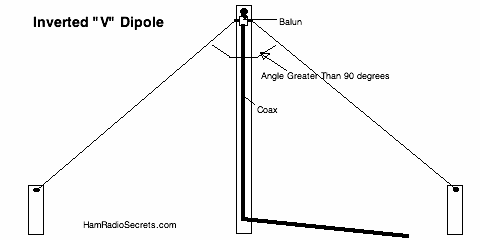
For a dipole, halve the answer to get each leg. For an end-fed half wave, the whole length runs in one direction from the unun. An inverted V needs a little more wire than the flat number because the sloping legs interact with the ground differently — about six percent more at a 90-degree apex, which the calculator adds for you once you tell it how far the ends droop.

Start here if you just want a number

These are the half-wave lengths at the centre of each band. They are a fine starting point, but read the license-class note underneath before you cut, because the centre of the band is not the centre of your privileges.

Half-wave lengths at the centre of each band. An end-fed half wave for the same band is the same total length — it is just fed at one end instead of in the middle.
BandCut forTotal wire (ft in)Total wire (metric)Each dipole leg
160 m1.900 MHz246 ft 3 3/4 in75.077 m123 ft 1 7/8 in
80 m3.750 MHz124 ft 9 5/8 in38.039 m62 ft 4 3/4 in
60 m5.360 MHz87 ft 3 3/4 in26.613 m43 ft 7 7/8 in
40 m7.150 MHz65 ft 5 1/2 in19.951 m32 ft 8 3/4 in
30 m10.125 MHz46 ft 2 5/8 in14.089 m23 ft 1 3/8 in
20 m14.175 MHz33 ft 0 1/4 in10.063 m16 ft 6 1/8 in
17 m18.118 MHz25 ft 10 in7.873 m12 ft 11 in
15 m21.225 MHz22 ft 0 5/8 in6.721 m11 ft 0 1/4 in
12 m24.940 MHz18 ft 9 1/8 in5.720 m9 ft 4 5/8 in
10 m28.400 MHz16 ft 5 3/4 in5.023 m8 ft 2 7/8 in
6 m50.150 MHz9 ft 4 in2.844 m4 ft 8 in
Building it

Cut it long. Trim it down. Never the other way around.

The calculator will hand you a number to a fraction of an inch, and it is right. Your yard is not. Trees, gutters, height above the ground, the metal roof on the shed — all of it shifts where the antenna is actually resonant, and none of it is in the formula.

So build long on purpose. For a 40 m end-fed, a lot of us start at 68 feet of wire and trim from there, even though the arithmetic says shorter. A few extra feet costs nothing and takes ten minutes to remove. Two inches short costs you a new run of wire and a splice you will be looking at for years.

Trim in small bites. Fold the extra back on itself and twist it rather than cutting, sweep it again, and only cut when you are sure. Do both legs of a dipole equally.

The other half of building it long is where you put it. Get the wire away from the house, away from gutters and downspouts, and as high as you can manage. If you can only get one support up, hang the middle from it and let the ends slope down — that is an inverted V, it takes one tree instead of three, and it works very nearly as well as a flat dipole for most of what we do.

Before you throw a line

Nothing on this page is worth a power line

Antenna wire is long, it is thin, and it is usually going up in the air on the end of something you threw. If it can reach a power line — falling, swinging, or blowing in a storm three months from now — put it somewhere else. Not higher, not more carefully. Somewhere else. This is the one mistake in the hobby that does not give you a second try.

Two more that are cheap to get right: put a lightning arrester where the coax enters the building and bond it to your station ground, and disconnect the feedline when a storm is coming through. And when you are transmitting, keep people and pets away from the ends of the wire, because that is where the voltage is highest — on an end-fed, the high-voltage end is the far end, out at head height if you hung it low.

Common questions

What people ask before they cut

What frequency should I cut my antenna for?

Pick the part of the band you actually operate in, not the middle of the whole band. A General licensee who runs 40 m phone lives near 7.225 MHz, and cutting for 7.150 MHz puts the antenna’s sweet spot down in a segment they are not allowed to transmit in. The calculator has the license segments built in, so you can pick Technician, General or Extra and it will show you the middle of the piece of the band you hold.

Why did my antenna come out resonant lower than the calculator said?

Almost always because it is closer to the ground, closer to the house, or surrounded by more metal and trees than the formula assumes. Height above ground is the biggest single factor. Insulated wire does it too — the jacket slows the signal down slightly and the antenna acts about three percent longer than the bare wire measurement. Set the wire type in the calculator and it accounts for that.

Do I still need a tuner if I cut it exactly right?

For one band, probably not. A half wave cut for the segment you operate in will usually land under 2:1 SWR across enough of the band to be useful, and most radios are happy there. You want a tuner when you are working several bands off one wire, when the antenna is low, or when you want the last bit of the band edge. A tuner does not fix a bad antenna, it just makes the radio comfortable feeding it.

Can one end-fed wire cover more than one band?

Yes, and that is the main reason people build them. A half wave on 40 m is also close to two half waves on 20 m, three on 15 m and four on 10 m, so the same wire and the same 49:1 unun will load up on all of them. The calculator lists which harmonic bands your length actually lands in rather than making you guess.

How high does the wire need to be?

Higher is better, and there is no point pretending otherwise. Half a wavelength up is where a dipole really starts to work for distance, but very few of us have that. A quarter wavelength up is a good working target and a lot of people do fine with less. If you can only get one end high, build it as an inverted V — the calculator adds the extra wire the sloping legs need.

Feet and inches, or metres?

Both, side by side, on every result. The tool shows the imperial formula and the metric formula together so you can see they are the same equation with a different constant, and every length is given in feet and inches and in metres. Use whichever tape measure is in your hand.

Keep going

The wire is one piece of it. These are the pages that cover the rest — what you are allowed to transmit on, how to tune what you built, and what all the words mean.