

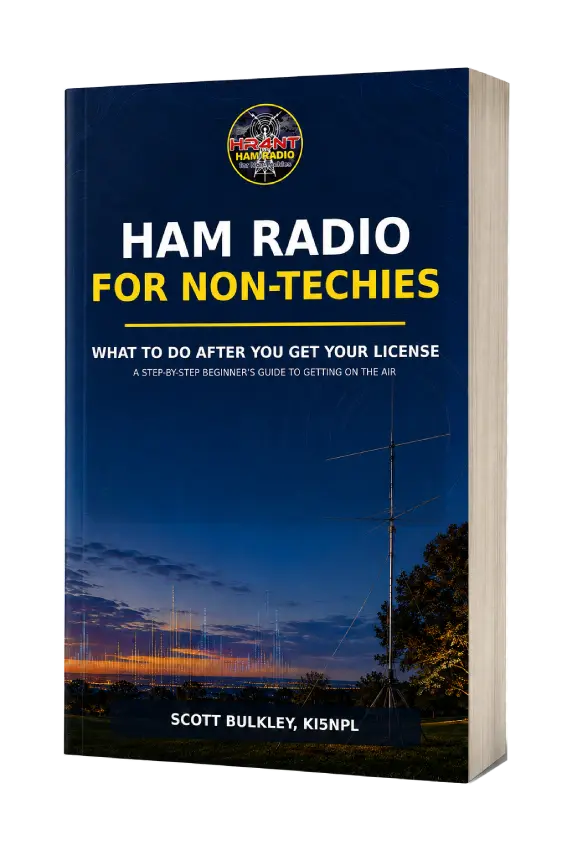
Ham Radio For Non-Techies Book
What to Do After You Get Your License
240 Pages
Paperback & Kindle
Reference Guide
A PRACTICAL GUIDE FROM HR4NT
You Passed the Test. Now Let’s Get You on the Air.
After years of contemplating this project I finally decided to write an actual book! This is a companion to my Youtube channel and I wrote it so you could have a handy reference guide you can take with you out in the field. I wanted to give as much useful info as I could think of without being a 10 volume set. Some of the chapters have QR codes that link to videos I made about the chapter topic so you can hear it as well as read about it. There is a full reference section in the 10 appendices in the back. Enjoy. Use the book. I truly hope I was able to contribute to your enthusiasm for the ham radio hobby.
Passing your amateur radio exam is a great feeling. Then you get your call sign, start looking at radios, antennas, programming software, repeaters, nets, and operating modes—and suddenly it can feel like you have more questions than answers.
I wrote Ham Radio for Non-Techies: What to Do After You Get Your License for that exact moment. This is not another book designed to help you memorize test questions. It is a practical, step-by-step guide to help you choose your next move, build a station that actually works, make contacts with confidence, and begin enjoying the license you worked hard to earn.
The License Was Only the Beginning
If You Are Licensed but Still Feel Lost, You Are Not Alone
The amateur radio exam teaches you the rules, basic electronics, safety, and operating knowledge required to earn your license. What it does not always teach is how to turn that license into a working station and a hobby you can actually enjoy.
That gap frustrates a lot of new operators. You may not know which radio to buy, whether you need an expensive antenna, how to program local repeaters, what to say when someone answers your call, or where you fit in a hobby with so many different directions. It is easy to spend money on equipment before you understand what you really need. It is even easier to let a new radio sit unused because getting started feels more complicated than it should.
I created this book to close that gap. My goal is to help you move from “I have a license” to “I know what I am doing next.” You do not need an engineering background, a room full of equipment, or a massive budget. You need a sensible path, a working first setup, and enough confidence to press the push-to-talk button and begin.
A Beginner’s Guide Built Around Real Decisions
No Hype. No Pressure to Buy Everything. No Assumption That You Already Know the Lingo.
Ham radio can become expensive when equipment is purchased without a plan. That is why this book begins with what you want to do, not with a shopping list. A radio that is perfect for one operator may be completely wrong for another. Your location, license privileges, budget, available space, and interests all matter.
Throughout the book, I help you make those decisions in the right order. You will learn how to set realistic goals, establish a budget, choose a first radio, assemble a complete working station, find activity in your area, and make your first contacts. From there, we work on the habits that turn a nervous beginner into a capable operator and show you how to decide whether HF, emergency communications, public service, digital modes, contesting, portable operation, or another part of the hobby belongs in your plan.
The guiding idea is simple: operate deliberately, keep evidence, and improve one weak link at a time. Buy new equipment only when your actual operating experience reveals a real limitation.
What This Book Will Help You Do
Choose a First Radio That Fits Your Goals
Instead of chasing specifications or buying whatever happens to be popular, you will learn how to connect the radio to the type of operating you actually want to do.
Build a Complete, Working First Station
A radio by itself is not a station. I walk you through the supporting pieces that make the radio usable, including power, feed line, antennas, programming, and basic station planning.
Find People and Activity to Listen To
You will learn how to locate repeaters, nets, clubs, calling frequencies, and other on-air activity so you are not endlessly turning the dial and hearing nothing.
Make Your First Contact with Confidence
The book includes straightforward scripts and examples that show you what to say, what information to exchange, and how to handle the contact without feeling as though everyone is waiting for you to make a mistake.
Develop Better Operating Habits
Good operators are not born knowing radio procedure. They improve through listening, repetition, and a few reliable habits. This book gives you a practical foundation without burying you in unnecessary jargon.
Create a Personal Path Through the Hobby
You do not have to do every part of amateur radio. By the end of the book, you will have a clearer idea of what interests you, what equipment supports it, and what your next realistic step should be.
More Than Advice: Practical References You Can Keep Using
The main chapters take you through the process of becoming an active operator, but the appendices are designed to stay useful long after your first contact. You will find contact scripts, the phonetic alphabet, common Q-signals, the RST signal-reporting system, equipment-inspection guidance, troubleshooting help, privilege references, planning worksheets, a glossary, and source information.
You do not have to remember everything at once. Keep the book near your station, return to the references when you need them, and work through the hobby one manageable step at a time.
Passing the test earns your license. Learning how to use it turns you into an operator.
Who This Book Is For
This book was written primarily for newly licensed U.S. amateur radio operators who are ready to get started but are not sure what to do next. It is also a good fit if you earned your license some time ago, bought a radio, and never became comfortable using it.
You will feel at home here if technical books tend to lose you, if equipment discussions seem full of unexplained shorthand, or if you simply want someone to put the steps in a sensible order. I explain the decisions in plain language and focus on what helps you get on the air safely, legally, and with confidence.
This is not an exam-preparation manual, and it is not written for advanced operators looking for deep engineering theory. It is the bridge between passing the exam and becoming an active ham radio operator.

About the Author
Scott Bulkley, KI5NPL
I am Scott Bulkley, KI5NPL, the creator of Ham Radio for Non-Techies and the HR4NT YouTube channel. I built HR4NT around a simple idea: amateur radio should be understandable and enjoyable even if you do not come from an electronics or engineering background.
I know how quickly this hobby can become overwhelming. There is always another acronym, another piece of equipment, and another operator with a different opinion about what you “must” buy. My approach is to slow the process down, explain why the pieces matter, and help you make decisions based on the kind of operator you want to become.
This book brings that same approach into one organized path you can follow at your own pace. My goal is not to turn you into a walking technical manual. It is to help you stop feeling stuck and start using your license.
The Full Chapter List
Ten chapters and an introduction, arranged in the order the decisions actually reach you — from working out what you want out of the hobby, through buying and building, to your first contact and what comes after it.
Introduction — The License Was Only the Beginning
Why passing the exam leaves so many new operators stuck, and what the rest of the book does about it.
Chapter 1 — What Do You Want to Do With Ham Radio?
Work out which parts of the hobby you actually care about before you spend a dollar. Every decision after this one follows from it.
Chapter 2 — Building a Ham-Radio Budget Without Wasting Money
Where the money really goes, what is worth paying for early, and the purchases new operators most often regret.
Chapter 3 — Choosing Your First Radio
How to match a radio to the operating you actually plan to do, rather than to whatever the forums were recommending this week.
Chapter 4 — Assembling Your First Working Station
Antenna, feed line, power and the connections between them, turned into a station that will genuinely get out.
Chapter 5 — Programming the Radio and Finding Activity
Getting repeaters, offsets and tones into the radio — then finding out where people are actually talking.
Chapter 6 — Making Your First Contact
What to say, when to say it, and how to get through that first transmission without the microphone freeze.
Chapter 7 — Becoming a Competent Operator
The habits that separate an operator other hams enjoy working from one they quietly avoid.
Chapter 8 — Taking the Next Step Into HF
Moving beyond the local repeater: what changes, what it costs, and what your license class actually permits.
Chapter 9 — Finding Your Place in Amateur Radio
A tour of what the hobby contains, so you can find the corner of it that fits you. There is a shorter version of that tour in what you can do with ham radio.
Chapter 10 — Your Personal Ham-Radio Plan
Turning all of it into a written plan for your next six months on the air.
Three Pages from the Book
Reference pages you use at the radio rather than read once and shelve. These three are reproduced from the printed book.
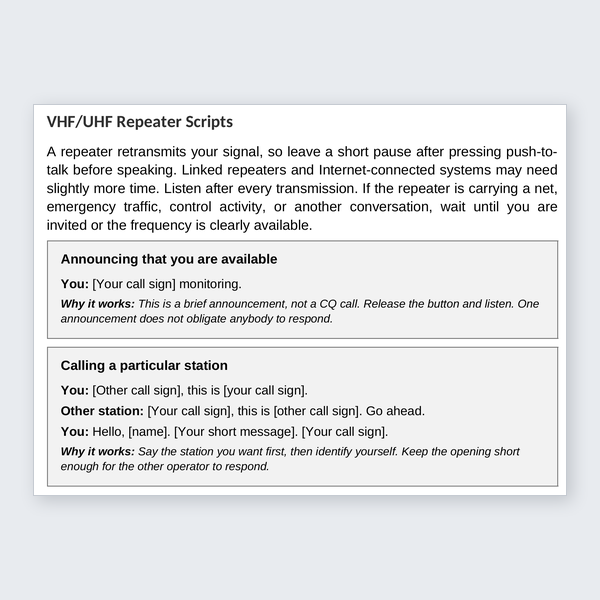
Beginner's On-Air Scripts
Word-for-word scripts for announcing yourself, calling a station and answering one — each with a note on why that phrasing works.
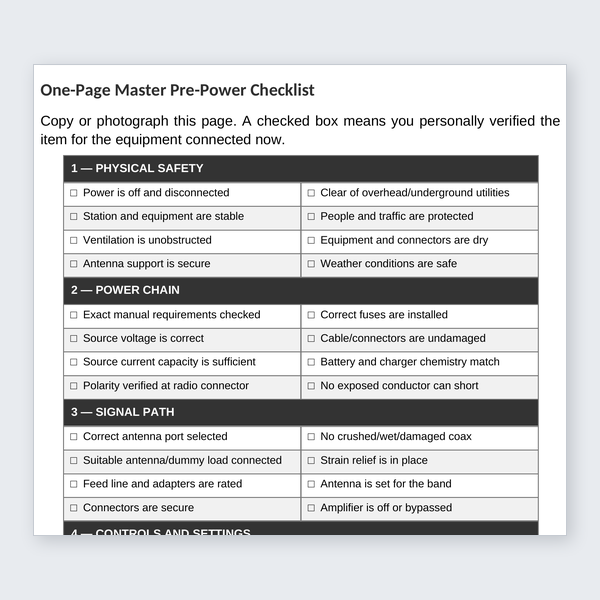
The Pre-Power Checklist
A one-page inspection to run before you key up: physical safety, power chain, signal path, then controls and settings.
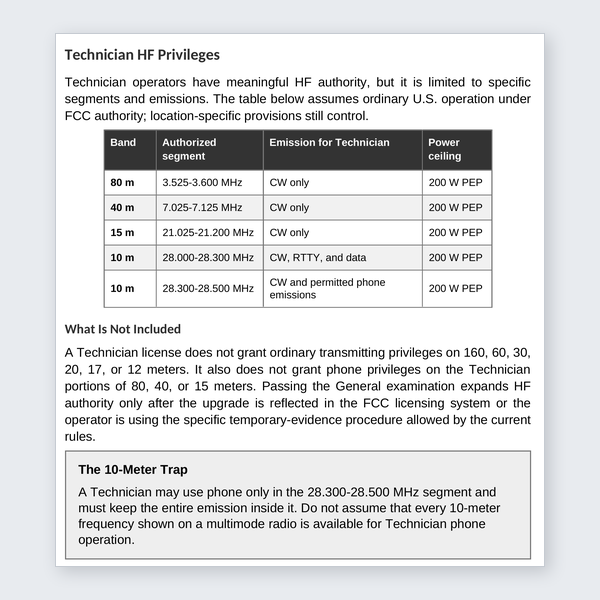
Technician HF Privileges
Band, segment, emission and power ceiling in one table — plus what a Technician license does not include, and the ten-meter trap.
Ten Appendices You Will Keep Coming Back To
The back of the book is built to be used at the operating position, not read straight through. Scripts to read from, tables to check, worksheets to fill in, and a checklist to run before you transmit.
A — Beginner’s On-Air Scripts
What to say, written out word for word.
B — NATO/ITU Phonetic Alphabet
The standard alphabet, and when it actually matters.
C — Essential Q-Signals
The ones you will really hear on the air.
D — RST Reporting System
How to give a signal report that means something.
E — Station Planning and Budget Worksheets
Fill-in pages for planning the station and what it will cost.
F — Pre-Power Inspection Checklist
The one-page safety check before you transmit.
G — Troubleshooting Guide
What to check, and in what order, when something is not working.
H — Current U.S. Privilege References
What each license class permits, by band and mode.
I — Ham Radio Glossary
Plain-language definitions for the jargon nobody explains.
J — Technical Sources, References, and Companion Resources
Where to go deeper on anything the book introduces.
Read It? Help the Next New Ham Find It.
Reviews are how a newly licensed operator, standing in front of a shelf of study guides that all look the same, works out which book will actually help them on Monday morning. If this one got you on the air, an honest review — whatever the rating — puts it in front of the person who needs it next.
Reader reviews will appear here as they come in.
Your Call Sign Is Ready. Your Next Step Is Waiting.
You already completed the hardest first step: you earned your amateur radio license. Do not let uncertainty, confusing advice, or the fear of making a mistake keep you off the air.
Ham Radio for Non-Techies: What to Do After You Get Your License gives you a practical plan for choosing equipment, building a station, making contacts, improving your skills, and finding the part of ham radio that belongs to you.
Start with what you have. Learn one step at a time. Make the contact.
Frequently Asked Questions
Is this book an amateur radio license study guide?
No. This book begins where most license study guides end. It is written for people who have earned their license and now want practical help choosing equipment, setting up a station, finding activity, and getting on the air.
Do I need technical or electronics experience?
No. I wrote the book in plain language for readers who do not come from a technical background. When a technical idea matters, I explain it in the context of the decision you are trying to make.
Will the book tell me exactly which radio to buy?
It will help you choose the right type of radio for your goals, budget, location, and license privileges. I do not believe one radio is automatically right for every beginner, so the book teaches you how to make a sound decision instead of pushing a one-size-fits-all shopping list.
Does the book cover making a first contact?
Yes. It explains how to find activity, listen before transmitting, use common operating language, make a call, respond to another operator, exchange the usual information, and end the contact naturally. Practical scripts and references are included.
Is this useful if I have been licensed for a while but never got on the air?
Absolutely. If your radio has been sitting unused or you still feel unsure when you pick up the microphone, the book will help you rebuild your plan and take a manageable next step.
Next up: back to the Ham Radio for Non-Techies home page — where the path from a new license to your first contact starts.