


Lithium Battery Safety for Ham Radio: How to Charge Your LiFePO4 Without Starting a Fire
Twelve special event stations go on the air in October to talk about battery charging safety. Here is what that actually means for the battery sitting under your operating desk — and the one rule about it that almost nobody tells you.
Somewhere between October 4 and October 10 you are going to tune across a station calling CQ as N3F or VE3FIRE, and if you are anything like me your first thought will be “special event — but for what?”
The answer is Fire Prevention Week, and this year the theme lands closer to your shack than any fire safety campaign ever has. The National Fire Protection Association picked lithium-ion battery charging as the 2026 focus, under the slogan Charge Into Fire Safety: Safe Charging Is a Superpower. Twelve ham stations are going on the air to help spread it around.
Here is why that is worth your attention rather than a shrug. If you operate portable, you own a lithium battery. Probably a good one. But “lithium battery” is not one thing, the differences matter enormously, and the mainstream fire safety coverage is not going to explain which kind you have or what changes because of it.
So let’s do that here. First the event, because it is a genuinely fun one to chase. Then the part that actually matters: what your battery is, what it is not, and the handful of charging habits that keep it boring.
The HamFire Special Event, October 4–10, 2026
HamFire runs ten regional stations, one for each US call area, signing N0F through N9F. Two wild card stations join them: KF2IRE in the United States and VE3FIRE up in Ontario. Twelve stations in total, spread over seven days.
This is not a contest. There is no exchange to memorize, no multiplier to chase, and nothing riding on your log. It is a public service event, which in practice means the operators want to actually talk to you — so if you have been avoiding HF because you are not sure what to say, this is about the friendliest place on the band to start.
Work ten of the twelve stations and you can download a printed certificate. Twelve stations across seven days sounds like a lot until you remember that each one runs midnight to midnight in its own local time, which gives you a genuinely wide window on every band that happens to be open.
The details at a glance
- Dates
- October 4 through October 10, 2026
- Stations
- N0F, N1F, N2F, N3F, N4F, N5F, N6F, N7F, N8F and N9F, plus wild cards KF2IRE (US) and VE3FIRE (Ontario)
- Hours
- Midnight to midnight, local time at each station
- Certificate
- Work 10 of the 12 stations for a downloadable printed certificate
- Frequencies and modes
- Published per station at hamfire.com, along with station schedules, QSL details and an FAQ. Check the VE3FIRE QRZ page too.
- Theme
- Safe charging of lithium-ion batteries — the NFPA’s 2026 Fire Prevention Week campaign
Your Battery Is Probably Not the One They Are Warning About
The batteries setting couches on fire in the news are mostly lithium-ion in the cobalt-oxide family — chemistries abbreviated NMC, NCA or LCO. They cram an enormous amount of energy into very little weight, which is exactly why they end up in phones, laptops, vape pens, e-bikes, scooters and drones. What you give up for that energy density is chemical stability.
The battery under your operating desk, if you bought it for ham radio, is almost certainly something else: LiFePO4, lithium iron phosphate, sometimes written LFP. Bioenno — the brand most of us started with — sells LiFePO4 exclusively. It is heavier per amp-hour than the phone chemistries, it lasts for thousands of cycles instead of hundreds, and it is dramatically harder to set on fire.
Here is the term worth knowing, because everything else on this page hangs off it. Thermal runaway is what happens when a battery cell gets hot enough that the heat itself generates more heat, faster than the cell can shed it. Past that point unplugging the charger does nothing, because the battery is no longer being heated from outside — it is cooking itself. The temperature where that starts is the number that separates a scare from a house fire, and the two chemistries are nowhere close to each other.
| LiFePO4 (your radio battery) | NMC / LCO lithium-ion (phones, e-bikes, drones) | |
|---|---|---|
| Thermal runaway starts near | 518°F (270°C) | 410°F (210°C) |
| Why | Phosphorus and oxygen are locked into a rigid crystal structure, so heat cannot pry the oxygen loose | Layered structure sheds oxygen under stress — which feeds the fire from inside the sealed case |
| Typical cycle life | Thousands of charge cycles | Several hundred charge cycles |
| Weight per amp-hour | Heavier | Lighter — the reason it is used where weight rules |
| Full charge voltage, 12 V pack | 14.6 V (3.60 V per cell) | Different chemistry, different charger — never interchange them |
Runaway temperatures are approximate and vary by cell and manufacturer. The gap between the two chemistries is the point, not the exact figures.
So your LiFePO4 is the safest lithium chemistry you can buy for this job, by a wide margin. That is not the same thing as saying you can do whatever you like with it — and it is definitely not true of everything else in your kit.
The Lithium Batteries in Your Shack That Do Deserve the Warning
Every one of these is the cobalt-oxide family, not LiFePO4 — and every one of them lives in a typical ham’s go bag.
Your HT Battery Pack
Most handhelds ship with lithium-ion or lithium-polymer packs, not LiFePO4. The drop-in desktop charger that came in the box is the right one — the bargain third-party replacement pack off a marketplace listing is where the trouble starts.
Cheap USB Power Banks
The one you tossed in the go bag years ago and never thought about again. No-name power banks are the single worst offender for missing protection circuitry, and they spend their lives buried in a bag under a pile of coax.
Drone and RC LiPo Packs
Some portable operators borrow hobby lithium-polymer packs to run a QRP rig because they are so light. LiPo is the least forgiving lithium chemistry there is. If you go this route, a fireproof charging bag is not optional.
The Laptop Running Your Digital Modes
An aging laptop battery that has started to swell will lift the trackpad or stop the case sitting flat on the desk. That is a battery telling you it is done, and it is sitting on the same table as your radio.
Five Charging Rules That Actually Matter
Nothing here is complicated and none of it costs money. It is mostly a matter of doing the same handful of things every time, until you stop having to think about them.
-
Use the charger built for the chemistry
This is the big one, and it catches people coming from lead-acid. A lead-acid charger delivers roughly 2.30 to 2.45 volts per cell. LiFePO4 wants 3.60. On a 12-volt pack that means a full charge sits at 14.6 volts, and Bioenno’s own guidance is a charger putting out a regulated 13.8 to 15 volts with current no higher than the pack’s rating. Worse, plenty of lead-acid chargers have a desulfation or equalize mode that deliberately pushes voltage well past that, which is a thing you never want aimed at a lithium pack. If your charger says “AGM,” “gel” or “flooded” on it and has no lithium setting, it is the wrong charger.
-
Keep the charge rate sane
The comfortable number is 0.5C — half the pack’s amp-hour rating, in amps. A 20 amp-hour battery is happy at 10 amps or less. Faster is technically possible on many packs and it buys you heat and a shorter life, which is a poor trade for a battery that would otherwise outlast the radio.
-
Charge on something hard that will not burn
Not the bed, not the couch, not a pile of coax, not carpet. Soft surfaces trap heat against the case and block the airflow the pack needs to shed it. A bare bench, a tile floor, or a sheet pan works. This rule exists because of the cobalt-oxide packs rather than your LiFePO4, but it costs you nothing to apply it to everything.
-
Unplug it when it is full
On a 12-volt LiFePO4, a resting voltage of 13.2 volts or higher means you are at 100 percent. Leaving a pack sitting on a charger indefinitely is stress it does not need. This goes double for the HT battery you leave in the drop-in cradle on the desk for weeks at a time.
-
Do not treat the BMS as a safety net
Most quality packs include a BMS or protection circuit module — a small board inside the case that cuts the pack off if it sees overcharge, over-discharge, or a short. It is genuinely good and it has saved a lot of batteries. It is also a last line of defense, not permission to be careless, and the cheapest packs on the market either skip it or fit one that does not do what the listing claims.
The Rule Nobody Tells You: Never Charge a Battery That Is Below Freezing
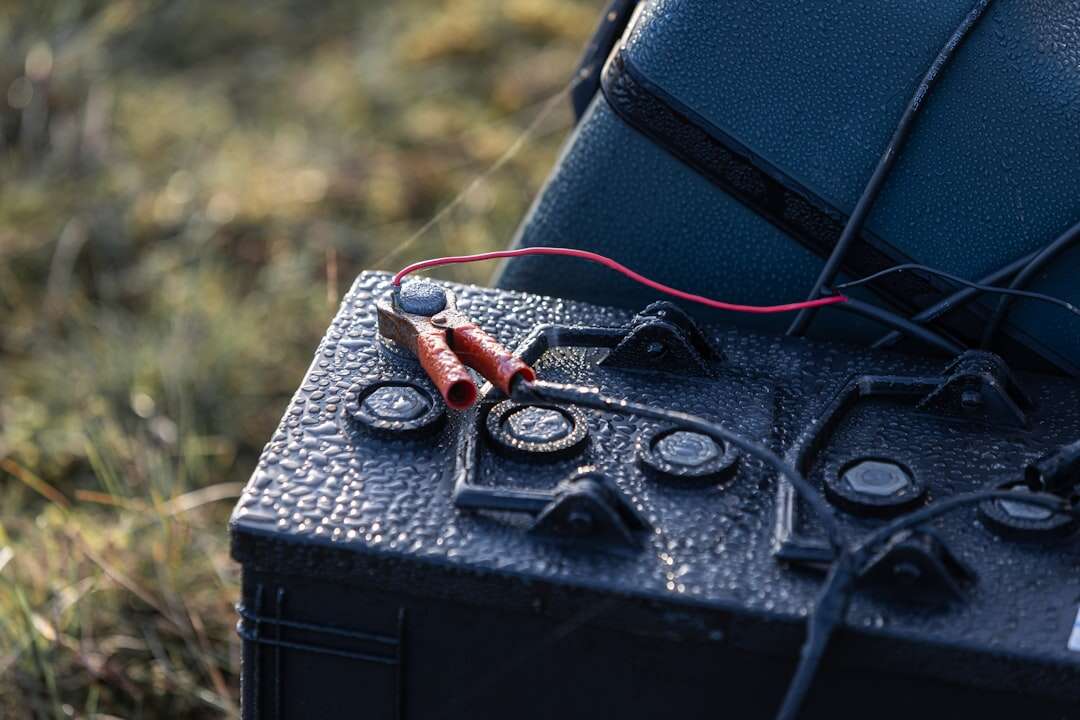
If you operate portable in winter, this is the most important paragraph on the page. Bioenno puts it about as plainly as it can be put: do not charge the battery below freezing as the cells may be damaged.
Here is the part that makes it sneaky. Discharging in the cold is fine. You can run a POTA activation at 25 degrees and your battery will power the radio perfectly well, with somewhat less capacity than it would give you in July. Nothing about that hurts it. Charging is the problem, and the two feel identical while you are doing them.
Below 32 degrees Fahrenheit, the lithium coming back into the anode does not slot into the material the way it is supposed to. It plates out as metal on the surface instead. That plating is permanent — it takes a little capacity with it every single time — and in the worst case it keeps growing until it bridges the inside of the cell and shorts it out. There is no smoke, no smell, no warning noise. The pack just quietly gets worse, and one day it fails in a way it should not have.
So bring the battery inside, let it come up to room temperature, and then charge it. The situation to think hardest about is solar in the field: the sun comes up, the panel starts pushing current, and it is pushing that current into a battery that spent the night at 25 degrees. Some packs have low-temperature charge cutoff built into the BMS. Plenty do not. Find out which kind you own before the weather makes it matter.
Signs a Battery Is Finished, and What to Do About It
A lithium pack almost always tells you before it does anything dramatic. The trouble is that the signals are easy to rationalize away, especially on a battery you paid good money for. Any one of these and it is done:
- Hot, not warm. Mild warmth while charging is normal. Uncomfortable to hold is not.
- Swelling. The case no longer sits flat, a seam has opened, or a soft pack has gone puffy like a pillow. This is gas inside the cell and it never goes back.
- Any smell at all. Sweet, chemical, solvent-like — all bad. A sealed cell should smell like nothing.
- Hissing or popping. Stop immediately and get clear.
- Physical damage. Dented, punctured, crushed, or dropped hard onto concrete. Internal damage does not have to be visible to be real, and it can show up days later.
- Voltage falling off a cliff. A pack that reads full and then collapses under load has a cell going bad.
If a pack does any of that, stop charging it, unplug it, and move it somewhere that does not care if it gets hot — a concrete floor, a metal bucket, outside and away from the house. Give it time to cool before you handle it more than you have to.
Then dispose of it properly, which means not in the household trash and not in the curbside recycling bin. A damaged lithium cell in a garbage truck compactor is exactly how landfill and recycling-facility fires start. Most hardware stores and home centers keep a battery recycling bin near the entrance, and Call2Recycle will find you a drop-off point by ZIP code.
Get on the Air for It
Twelve stations, seven days, and a certificate if you catch ten of them. It is a low-pressure way to work some new call areas, and the operators on the other end genuinely want the conversation. Station frequencies, modes and schedules are posted at hamfire.com.
If you are still sorting out your own portable power, start with the gear rundown — and if you are working out how much power you can safely run and where to put your antenna, the calculators on this site will do the math for you.