


The Low Bands Are Waking Up:
What Fall and Winter Change on 160, 80 and 40
Ten meters is getting quieter every month. The bands underneath it are about to have their best season of the year, and the reason has as much to do with thunderstorms as it does with the sun.
If you got your license in the last couple of years, you got in near the top of the solar cycle. Ten and fifteen meters were wide open, a hundred watts and a wire reached across oceans in the afternoon, and everybody told you that was normal.
It is not normal. It was the good years, and they are ending. The sun peaked in late 2024 and has been sliding downhill since.
Here is the part nobody mentions in the same breath. While the top of the shortwave spectrum gets worse, the bottom of it is heading into its best months of the year, and it does that every single year regardless of what the sun is doing. October through March is when 160, 80 and 40 meters come alive.
What follows is why that happens, in plain language, including three things that get repeated constantly in ham circles that are not actually true.
The Sponge in the Sky
Around thirty to fifty-five miles up there is a layer of the atmosphere that behaves very differently from the ones above it. Higher layers act like a mirror and bounce your signal back to earth, which is the whole basis of long distance shortwave. This low one does not reflect anything. It absorbs.
Sunlight is what switches it on. When the sun is up, its energy knocks electrons loose down there, and those loose electrons are the problem. Your radio wave sets them wobbling, they immediately bump into the thick soup of ordinary air molecules at that altitude, and the energy they carry turns into a tiny bit of heat instead of continuing on its way. Your signal does not get reflected, it gets eaten.
Lower frequencies get eaten far worse than higher ones. The reason is straightforward once you picture it: a slower wave swings each electron harder and further, so it arrives at each collision carrying more energy to lose. That is why 160 meters is hopeless at lunchtime while 20 meters is fine.
When the sun goes down, that absorbing layer largely collapses, and signals that could not get out of the county at noon suddenly go a thousand miles.
Myth one: "the D layer disappears at night"
You will read this everywhere, including in study guides. It is a teaching simplification, and on 160 meters it is misleading enough to matter.
The absorbing layer does not vanish after dark. It drops by a factor of a hundred or more, but it never quite goes to zero, and because low frequencies are so sensitive to it, even that small leftover amount has a real effect on topband. That is a large part of why 160 is so temperamental, why two nights in a row can be completely different, and why people who chase DX down there talk about conditions the way farmers talk about weather.
Say "collapses" rather than "disappears" and everything about the low bands makes more sense.
It's Mostly About Thunderstorms
Three things stack up in winter’s favor, and the one everybody forgets is the biggest.
The nights are longer. More hours of darkness means more hours with that absorbing layer collapsed. It also means more paths where both you and the station you are trying to work are in darkness at the same time, which on 160 meters is close to a requirement rather than a bonus.
The sun sits lower. Less direct sunlight reaching that layer means less absorption even during the day.
And the lightning stops. This is the one that actually decides whether your evening is enjoyable. Roughly two-thirds of all cloud-to-ground lightning in the United States happens in June, July and August. Individual winter months account for only a few percent each, and across the northern plains in midwinter there are months with essentially none at all.
That matters because lightning is a radio transmitter. Every strike puts out a burst of noise right across the low bands, and here is the cruel part: that noise travels by exactly the same nighttime skywave that carries your signal. So on a summer night you are not just hearing local storms. You are hearing a whole continent’s worth of them, arriving from a thousand miles away, at the same time your own signals start getting out.
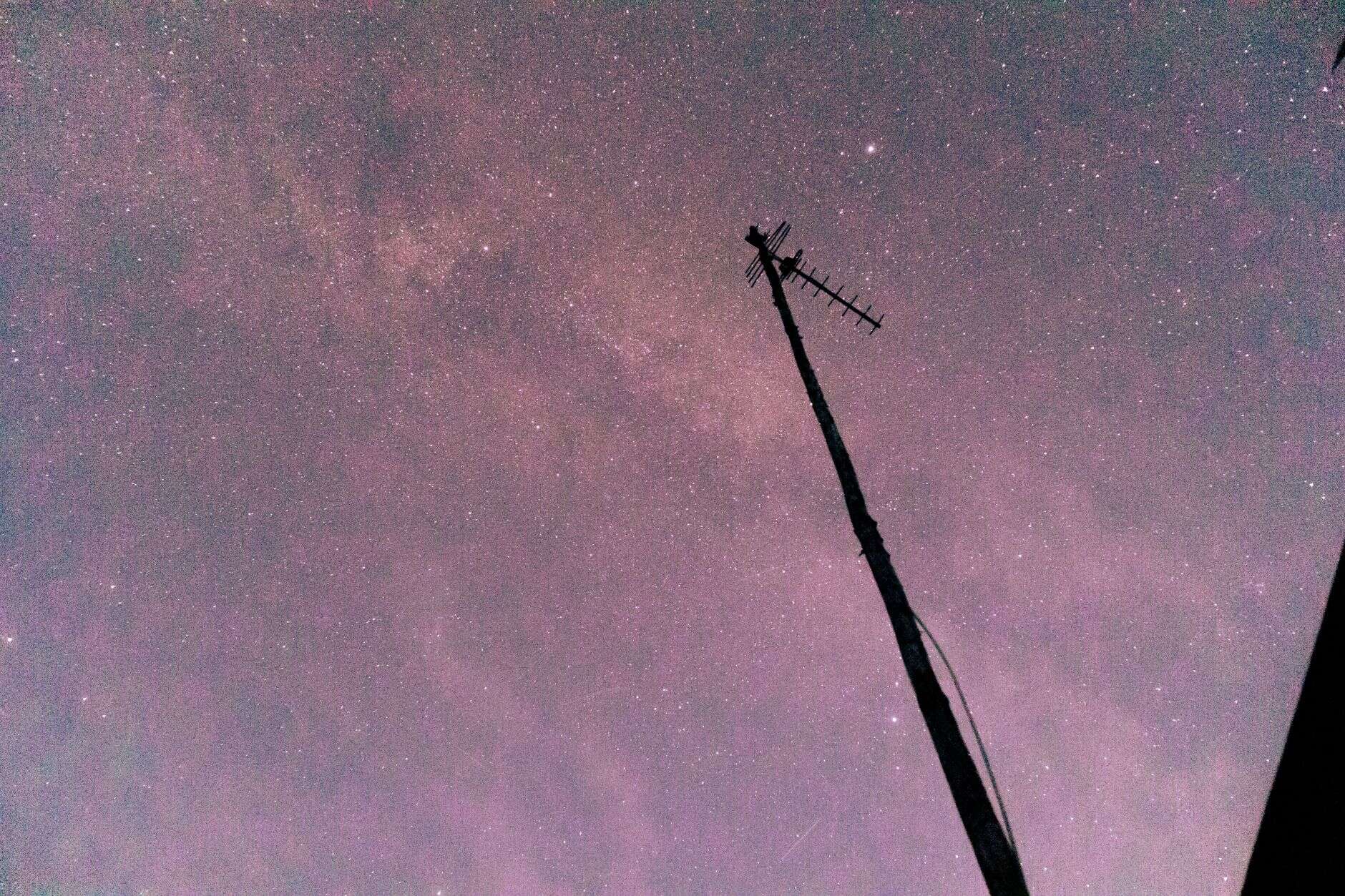
In July, a quiet evening on 80 meters means a steady crackle you have to listen through. In January, the same band can be genuinely silent between signals. Nothing about your station changed. The weather did.
Worth one honest footnote, because we would rather tell you than have somebody correct you later. The “less sunlight means less absorption in winter” part is true as a general rule but not an absolute one. There is a well documented oddity where, on some winter days at our latitudes, daytime absorption is actually higher than a normal summer day, and it varies unpredictably from day to day. It is a daytime effect and it does not undo any of the nighttime story above, but if somebody on the air tells you winter absorption is not always lower, they are right.
The Twenty Minutes Around Sunrise
There is a line running around the earth that separates day from night, and it sweeps across your location twice a day. Hams call it the grey line, and the short window while it passes over you is the best chance you will get on the low bands.
The reason is simple enough. Right at that boundary the absorbing layer has either not switched on yet or has just switched off, while the reflecting layers higher up are still doing their job. For a little while you get the best of both: a working mirror overhead and nothing underneath it eating your signal.
The practical detail that matters most is how long it lasts, because it depends enormously on the band. On 20 meters the window can run an hour or two. On 160 meters it can be a matter of minutes. Operators who work serious distance on topband report windows of fifteen to twenty minutes, and stations only a few hundred miles apart hitting their peak at noticeably different times.
So if you want to try it, be sitting there with the radio warmed up a quarter of an hour early. Turning it on at sunrise means you have already missed it.
Myth two: "signals travel along the grey line"
This is the most repeated explanation in ham radio and it is probably wrong. The picture people have is of signals shooting sideways down the terminator like a tunnel, and research published in the ARRL's own technical journal argues that propagation directly along that boundary is very unlikely and would be extremely lossy if it happened.
What appears to be going on is less romantic and more useful: the tilt of the ionosphere right at the boundary helps signals get up into an efficient path, and you happen to be enjoying a short spell when almost nothing is absorbing them.
The practical difference is real. It means you should not be aiming your antenna along the terminator. Point it where the station you want actually is, and use the timing rather than the direction.
One genuinely surprising tip from the same work: during a grey line opening, the best direction to listen may not be the best direction to transmit. Turning a receiving antenna slightly toward the daylight side can drop the noise more than it drops the signal, which leaves you hearing better.
Why This Winter Is Different From the Last Two
Everything above happens every year. What makes this particular season worth writing about is where we are in the eleven year solar cycle.
The current cycle peaked in late 2024 and has been declining since, with the next minimum expected around the end of the decade. For the top of the spectrum that is straightforwardly bad news: less energy from the sun means a weaker reflecting layer, which means 10 and 15 meters open less often, for shorter periods, to fewer places.
For the low bands, hams will tell you the opposite is true, and they are mostly right, but usually for the wrong reason.
The common explanation is “less solar activity means less absorption.” There is something to that, but the bigger factor is that the earth’s magnetic field tends to be calmer around solar minimum. A calm magnetic field means a more stable, more predictable ionosphere, and that matters enormously on paths that run anywhere near the poles, which is most of the interesting DX from North America.
Myth three: "the winter high band bonus will still be there"
There is a long-standing rule of thumb that December is the best month on 10 meters, because the daytime reflecting layer gets a seasonal boost in winter. It is a real effect and it is well documented.
What almost nobody mentions is that the effect is switched on by solar activity. Research on this shows the winter boost only appears in our part of the world when solar flux is running above roughly ninety units, and it gets stronger as solar activity increases.
Which means it is going away. As the cycle winds down and flux settles below that threshold, the winter high band bonus quietly stops arriving, while the winter low band advantage carries on exactly as before, because it is built out of long nights and an absence of thunderstorms and neither of those cares what the sun is doing.
That is the single best argument we can give you for spending this winter learning 40 and 80 meters.
One more honest correction while we are here. The declining phase of a cycle is not a period of uninterrupted calm. Large holes in the sun’s atmosphere become more common as activity falls, and they fire streams of fast solar wind at us that stir up the earth’s magnetic field. Because the sun rotates roughly every twenty-seven days, these disturbances tend to come back on a schedule.
So the honest picture is not “quiet from here on.” It is fewer of the sudden flare-driven upsets, more of the recurring stream-driven kind, and genuinely excellent stretches in between. If a night on 80 meters sounds terrible for no obvious reason, check whether the magnetic field is disturbed before you blame your antenna.
Antennas, Without the Hand-Waving
The low bands are harder than the high bands, and it is worth being straight about why rather than pretending a dipole is a dipole.
The obvious problem is size. A full size half wave dipole for 160 meters is about 246 feet long. A quarter wave vertical for it stands roughly 123 feet tall. Most of us do not have that, and that is fine, but it is the first thing that makes these bands different.
The less obvious problem is the one that actually decides whether you work anybody far away.
Your antenna does not have a “takeoff angle”
This phrase gets used as though it were a property of the antenna, like its weight. It is not. The angle your signal leaves at is the result of your antenna’s radiation combining with the copy of itself that bounces off the ground underneath it. Those two add up in some directions and cancel in others, and the pattern that results depends almost entirely on how high the antenna is measured in wavelengths, not in feet.
That distinction does all the work. A dipole thirty-five feet up is roughly a quarter wavelength high on 40 meters. At that height, the ground reflection sends almost everything more or less straight up.
Straight up is not useless. It is genuinely excellent for talking to everyone within a few hundred miles, which is exactly what you want for a state net or regional emergency traffic. But signals going nearly vertical come down close to home. For real distance you need energy leaving at a very shallow angle, on the order of a few degrees above the horizon, and a low dipole simply does not put much energy there.
This is why height matters so much more on the low bands than on 20 meters, and why the same wire that makes you a strong local signal on 40 makes you invisible across an ocean. Nothing is broken. It is geometry.
Which is why people use verticals, and what they cost
A vertical antenna produces that low angle radiation without needing to be high, which is why serious low band operators use them. The catch is what happens underneath. The current has to return through the soil, and soil is a poor conductor, so a chunk of your power quietly turns into warm dirt.
Radials are the fix: wires laid out on or just under the ground that give the current a copper path home instead. More is better, and the improvement is steady rather than sudden. Going from a handful of radials to a few dozen makes a real measured difference, and going further keeps helping with diminishing returns.
If that sounds like a lot of work, two encouraging facts. An inverted L, which goes up as far as you can manage and then runs horizontally, gets you most of the benefit in a small yard. And even a single elevated quarter wave radial makes a substantial difference compared to none.
The thing nobody tells beginners
On the low bands, what limits you is usually not how loud you are. It is how much noise you are sitting in.
That changes the arithmetic completely. A separate small receiving antenna that hears less noise can do more for your results than a bigger transmitting antenna that hears more of everything. It is why low band operators end up with one antenna for talking and a different one for listening, which looks eccentric until you understand the problem. If you have been fighting your noise floor, go back and read our piece on tracking down household interference first, because that work pays off down here more than anywhere else.
When to Be on Which Band
A rough guide for an operator in the United States. Treat it as a rule of thumb rather than a timetable, because any given night can defy all of it.
| Season | 160 / 80 / 40 | 20 / 15 / 10 |
|---|---|---|
| October and November | Improving fast. This is the season opener and the best time to get an antenna up. | Recovering after the summer, but weaker each year as the cycle declines. |
| December to February | The peak. Longest nights of the year and lightning at its annual minimum. If you try topband once, try it now. | 20 meters still reliable in daylight. 10 and 15 increasingly a lunchtime-only affair. |
| March and September | Still good, on the way down in spring and on the way up in fall. | The best of the year for the high bands. The weeks around the equinoxes are when they behave best. |
| April and May | Declining as the first thunderstorms arrive and the nights shorten. | Weakening, but sporadic openings on 10 and 6 meters start appearing. |
| June to August | The worst of the year. Two-thirds of the country's lightning happens now. 40 meters is still workable at night; 160 is often a write-off. | Short openings, plus the summer sporadic season on 10 and 6 which is its own kind of fun. |
If you want a date to aim at, the ARRL runs its 160 Meter Contest on the first full weekend of December, which is not a coincidence. It is Morse code only, so it is not for everybody, but it is the weekend when the band is busiest and the easiest time to find out whether your antenna works down there. Worth noting for anyone feeling outgunned: the ARRL points out that some operators go into it with five watts.
For 160 specifically there are also dedicated contest weekends in late January and late February, one for Morse and one for voice.
Questions People Actually Ask
What time should I actually be on?
Sunset through late evening is the dependable window and the easiest place to start. The hour around your own sunrise is the one serious operators set an alarm for, because that is when the long distance paths tend to open. If you are only going to try once, try then.
How far can I realistically get on 40 meters at night?
Further than you would think. A single bounce off the ionosphere covers something like two thousand miles, which from most of the country means you can reach essentially anywhere in North America. Across the Atlantic from the East Coast takes two bounces and is a normal winter evening’s work rather than a rare event.
Do I need a giant antenna to start?
No. A dipole in the backyard at whatever height you can manage will get you regional contacts on 40 and 80 straight away, and that is a perfectly good place to begin. The height and the radials only become the deciding factor when you start reaching for distance.
Why did 80 meters sound fine in January and awful in July?
Thunderstorms, almost certainly. The band did not change. The continent filled up with lightning, and on a summer night you hear all of it, not just the storms you can see.
Is it worth learning the low bands if the sunspots are going away?
That is precisely the argument for it. The high bands are going to be thinner for the next several years. The low bands are about to be at their best, and they will still be at their best every winter regardless of the cycle. Learning them now means you have somewhere good to operate for the rest of the decade.
My noise floor is terrible. Should I bother?
Fix the noise first, then come back. On these bands noise is the thing standing between you and everyone else, far more than power or antenna size. An afternoon spent hunting down a bad power supply will do more for your 80 meter results than any purchase.
See What the Bands Are Doing Right Now
Propagation Forge shows current conditions band by band and explains what the numbers mean in plain English, so you can tell the difference between a dead band and a disturbed one before you start rearranging antennas. Free, in your browser, nothing to install.