


Solar Cycle 25 Is Heading Downhill: What the Decline Actually Does to Your Bands
Ten meters is getting quieter and it is not your antenna. Here is what the sun is actually doing, band by band, what you get in exchange, and roughly how long the slide lasts.
If you got your license in the last three or four years, you got lucky. You came in while the sun was busy, ten meters was open to the world most afternoons, and a hundred watts into a wire in the backyard could get you Japan. That was not normal. That was the top of the cycle, and it is over.
I am not writing this to be gloomy about it. I am writing it because I keep seeing the same post in every ham group: someone convinced their radio has gone deaf, or their SWR has drifted, or the new antenna they just spent a weekend on is a dud. Usually none of that is true. The sun is just doing what the sun does, and nobody explained the schedule.
So here is the schedule, in plain English. What the sun has to do with your signal at all, where we actually are right now, what happens to each band on the way down, and the genuinely good things that come with the decline that nobody ever puts in the headline.
What the Sun Has to Do With Your Signal
Your HF signal does not travel in a straight line to Japan. It goes up, hits an electrically charged layer of the upper atmosphere, and bends back down somewhere far away. Do that once or twice and you have crossed an ocean. That charged layer is the ionosphere, and the thing doing the charging is the sun.
Specifically, ultraviolet and X-ray light from the sun knocks electrons loose from the thin air up there. More light means more loose electrons, and more loose electrons mean the layer can bend a higher frequency back down instead of letting it sail off into space. The layer that does the heavy lifting for long-distance work sits roughly 90 to 250 miles up and is called the F2 layer.
That gives you one number that matters more than any other: the MUF, or maximum usable frequency. It is the highest frequency that will still bend back down to a given place at a given moment. Transmit below the MUF and your signal comes back to earth. Transmit above it and it goes straight through and keeps going. A band is “open” when the MUF for that path is above the band you are on, and “dead” when it is not — that is the whole trick.
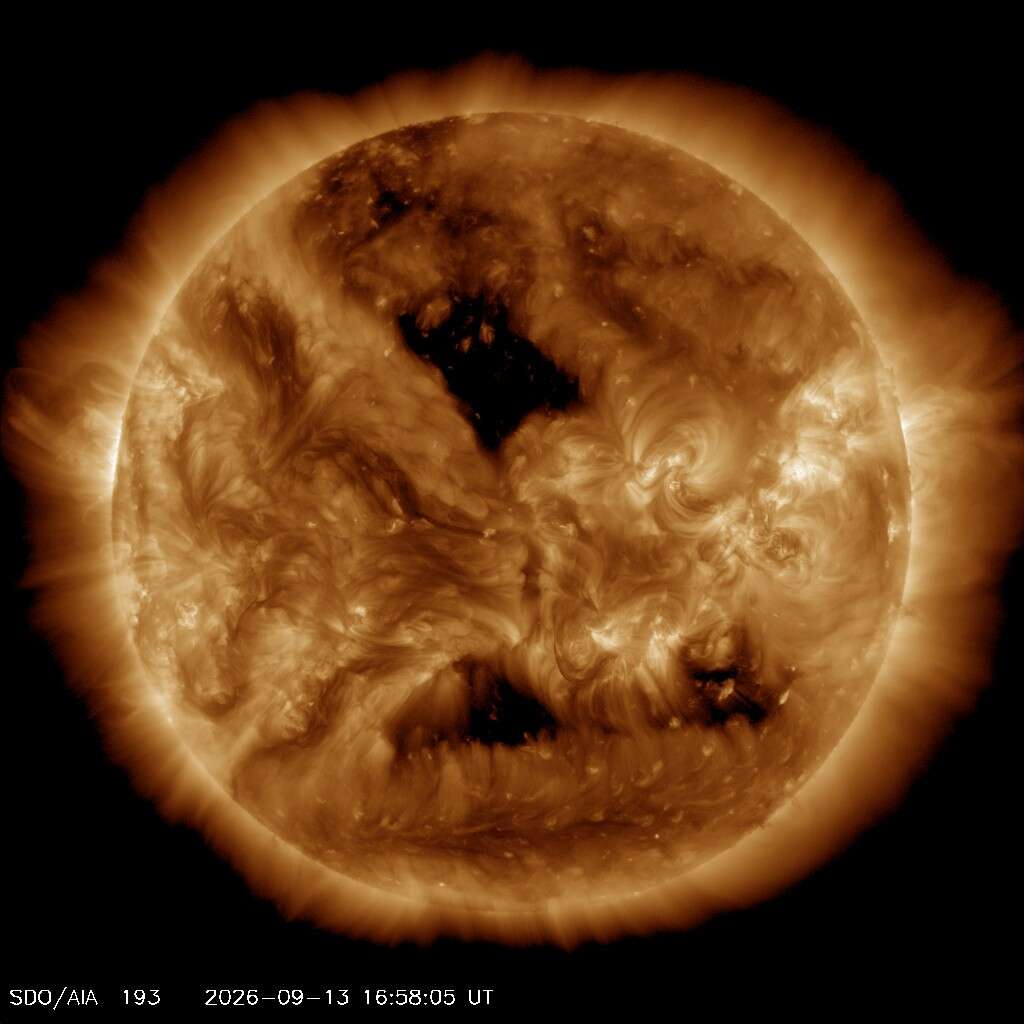
Sunspots are the visible sign of the magnetic activity that produces all that ultraviolet light. So when people quote a sunspot number or a solar flux index, they are really quoting a proxy for how high the MUF is likely to get today. High numbers push the MUF up and the high bands open. Low numbers let it sag and the high bands close.
The Peak Was October 2024. We Are Two Years Past It.
Cycle 25 turned out considerably better than the forecasters expected. The official prediction panel called for a maximum around 115, and the cycle went well past it. It also arrived early — the smoothed sunspot number topped out near 161 in October 2024, and everything since has been the long walk back down.
Two things about that are worth understanding, because they explain a lot of the confusion you see online.
The “smoothed” number is always looking backward. It is a thirteen-month running average, which means it cannot tell you where the peak was until you are already most of a year past it. That is why the announcement that a cycle has peaked always lands long after the good conditions started fading. Nobody was hiding it from you — the math simply takes that long.
The slide is not a smooth ramp. Day to day you are riding the sun’s 27-day rotation, so an active region swings into view, the flux jumps for a week, and then it rotates around the back and the numbers sag again. Plenty of individual days on the downslope will be better than plenty of days near the peak. The trend is down; the weather is noisy.
Cycle 25 by the numbers
- Maximum
- October 2024, smoothed sunspot number about 161
- Original forecast
- A maximum near 115 — the cycle comfortably beat it
- Solar flux today
- 109 as of September 12, 2026 (NOAA Space Weather Prediction Center)
- For comparison
- Flux ran in the 150s to 200s through much of the peak years
- Expected minimum
- Around 2030, give or take
- Cycle 26 begins
- Somewhere between January 2029 and December 2032, per NOAA’s current range
Solar flux is measured in solar flux units at 10.7 cm wavelength. As a rough working rule: under about 90 the high bands struggle, 90 to 120 is workable with patience, and above 150 is when ten meters starts behaving like it did in 2024.
What Happens to Each Band on the Way Down
The rule is simple: the higher the band, the more it depends on the sun, so the higher the band, the harder the decline hits it. The bands at the bottom barely notice, and some of them get better.
| Band | What the decline does to it | Verdict |
|---|---|---|
| 10 m | Hit first and hit hardest. Goes from open-to-the-world afternoons to sporadic, then to sporadic-E season in early summer and not much else. This is the band people notice going away. | Worst affected |
| 12 m | Follows ten meters down a step behind. Still produces openings, just fewer of them and shorter. | Fading |
| 15 m | Narrows to a daytime band with a real closing time in the evening rather than something open at all hours. | Shorter days |
| 17 m | Holds up better than you would expect for a while, then starts behaving like 15 m did a year earlier. | Hangs on |
| 20 m | The workhorse. Twenty stays usable through the entire cycle, minimum included — it is the band that is open when nothing else is, which is exactly why it is called the queen of the bands. | Your safe bet |
| 30 m | Quietly excellent and largely indifferent to the cycle. Worth learning if you have ignored it. CW and data only. | Steady |
| 40 m | Improves for DX. Less daytime absorption to fight and a lower MUF means the long paths that used to be on 20 m show up here after dark. | Gets better |
| 80 m | Comes into its own at minimum. Winter nights on 80 m during a solar minimum are the real thing — if you have the space for an antenna. | Gets better |
| 160 m | The top band rewards solar minimum more than any other. Very quiet sun plus a winter night is when it is at its best. Also the hardest to put up an antenna for. | Best at minimum |
| 6 m | Loses the F2 openings that made the peak years remarkable, but sporadic E in late spring and summer has nothing to do with the cycle and keeps happening regardless. | Seasonal, not solar |
Four Things That Get Better as the Sun Quiets Down
A quiet sun is not simply a worse sun. Several things that make operating frustrating at the peak go away on the downslope.
A Much Quieter Band
Fewer flares and fewer coronal mass ejections means less geomagnetic racket. The background noise on the low bands drops, and weak signals you would never have dug out at the peak become readable.
Far Fewer Blackouts
At the peak, a big X-class flare can wipe out HF on the daylight side of the planet for hours with no warning. Those get rare. What you lose in ceiling you gain in reliability — which matters if you do any emergency communications work.
Better Grey Line
The grey line is the moving band of twilight circling the earth, and signals following it travel remarkably well. A calm ionosphere makes that effect more dependable, so sunrise and sunset become the times you actually plan around.
The Low Bands Wake Up
Eighty and 160 meters at solar minimum on a winter night are as good as they ever get. Operators who have only ever chased the high bands have an entire side of the hobby waiting for them down there.
Five Ways to Change How You Operate
-
Put your next antenna dollar into a low band
If your station is a ten and twenty meter setup, the next four years favor 40 and 80. That does not have to mean a tower. A full-size 40 m dipole, an inverted V with the ends bent to fit the yard, or an end fed half wave will all get you into a band that is about to be the good one. That is a much better return than a better ten meter antenna right now.
-
Stop tuning around and start looking first
At the peak you could spin the dial and find something. On the downslope the openings are narrower, so five seconds checking the MUF and current conditions before you pick a band saves you an hour of hearing nothing. That is the entire reason the propagation tools on this site exist.
-
Learn the clock, not just the band
Bands stop being all-day and start having hours. Fifteen opens mid-morning and shuts in the evening; 40 turns into a DX band after dark; the grey line at your sunrise is a genuine event worth setting an alarm for. Operating at the right time beats operating with more power.
-
Use the weak-signal modes for the marginal openings
FT8 and the other digital modes will make contacts on a band that sounds completely dead on SSB, because they work well below the noise floor. You do not have to love them or use them exclusively — but on a marginal band they will tell you an opening exists, and then you can go call CQ on it.
-
Take the ten meter openings when they come
Ten is not gone, it is just no longer reliable. Sporadic E in late spring and early summer opens it regardless of the sunspot count, and there will be good F2 days for a few more years. Keep the antenna up and check it when the flux jumps.
How Long Does This Last?
The honest answer is that nobody knows precisely, and you should be suspicious of anyone who says otherwise. Minimum is expected around 2030, and NOAA currently puts the start of Cycle 26 somewhere between January 2029 and December 2032 — a four-year window, which tells you how much slack there is in the prediction.
Here is the useful way to hold it. The eleven-year figure everyone quotes is an average, not a schedule. Cycles have run as short as nine years and as long as fourteen. Cycle 25 itself came in early and stronger than the panel predicted, which is a fair reminder that the forecasts get revised because the sun does not read them.
So: expect the high bands to keep thinning through the late 2020s, expect the low bands to be the place to be around 2029 and 2030, and expect the whole thing to start over after that. If you are newly licensed, you are about to see the other half of the cycle — and knowing what it looks like is the difference between thinking your station is broken and knowing exactly which band to get on tonight.
Check the Bands Before You Turn the Radio On
Propagation Forge shows you the current MUF and what is actually open right now, so you can pick the band instead of guessing at it. If the answer is a low band and you need an antenna for it, the length calculator will give you the dimensions.