


Samuel Morse Was a Painter First
(And So Am I)
Before he ever sent a dot or a dash, Samuel Morse spent about twenty-five years as a working portrait painter. Here is the half of his story most hams never hear, and why it matters to anyone who owns both a key and a paintbrush.
Say the name Samuel Morse to a room full of hams and everybody pictures the same thing. A brass key. A wooden desk. Dots and dashes clicking out along a wire.
Nobody pictures him standing at an easel with a brush in his hand and paint on his sleeve.
That is what he was, though, and not as a weekend hobby. Painting was his profession for roughly twenty-five years. He trained for it in London, he made his living at it, and he was still calling himself an artist long after most people would have given up.
I have a personal reason for finding that interesting. I hold an Amateur Extra license and my call sign is KI5NPL. I also paint. My abstract work hangs at the Sugar Land Art Center & Gallery and lives online at ScottBulkleyArt.com, and when I mentioned it during a recent appearance on the Ham Radio 2.0 channel, I am not sure everyone listening knew quite what to do with it.
Ham radio and abstract painting do not sound like they belong in the same sentence. Samuel Morse settled that argument about two hundred years ago.
Before the Dots and Dashes, There Was a Paintbrush
Samuel Finley Breese Morse was born in Charlestown, Massachusetts on April 27, 1791, and graduated from Yale in 1810. He picked up spending money at school painting small portraits of classmates and teachers, which tells you where his head already was.
His family wanted something steadier for him. He went to England anyway. On July 15, 1811 he sailed with the American painter Washington Allston, and before that year was out he had been admitted to the Royal Academy of Arts in London. The painting he produced there, The Dying Hercules, drew real critical attention.
That is not a man dabbling. That is a man training.
He came home in 1815 and built a career on portraits. Photography did not yet exist in any practical form, so if you wanted a record of a face, somebody had to paint it. Morse painted President James Monroe in 1820 on a commission from the city of Charleston. In 1822 he finished a seven-by-eleven-foot canvas of the House of Representatives in session, a subject nobody had attempted before.
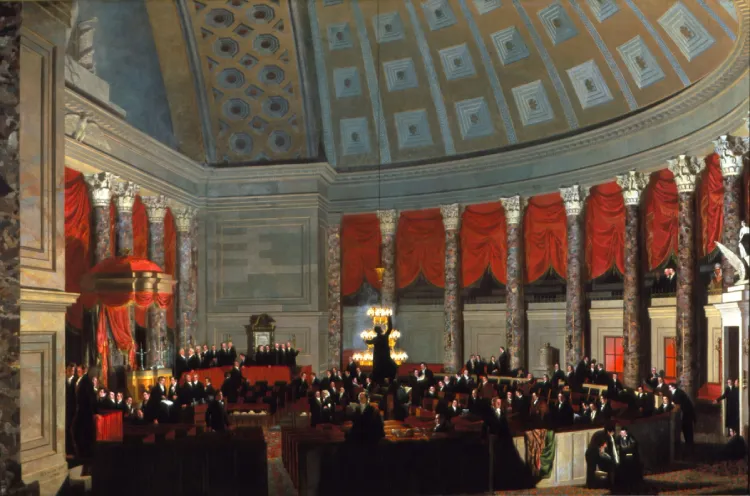
By every measure that counted at the time, he had arrived.
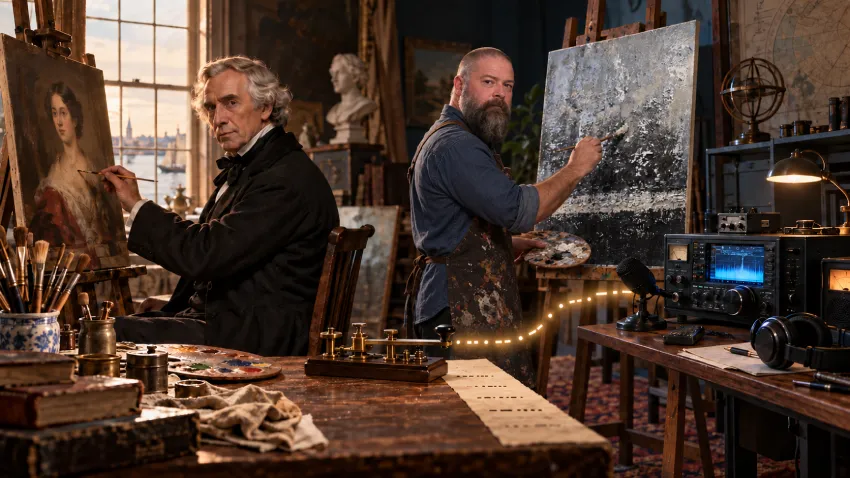
The Worst Thing That Ever Happened to Him
In 1825 the City of New York commissioned Morse to paint the Marquis de Lafayette. That was about as big as an American commission got. Lafayette had fought for the American cause in the Revolution and was touring the country as a living monument, and the city picked Morse to put him on canvas.
Morse was in Washington working on that portrait when his wife Lucretia died at home in New Haven on February 7, 1825, shortly after giving birth. Word went out by horse. By the time the letter reached him and he got back to Connecticut, she had already been buried.
I do not think you can read that and feel nothing. A man loses his wife and the news crawls toward him at the speed of a horse.
How much that pushed him toward the telegraph is something historians still argue about, and I am not going to pretend it is settled. What is not in dispute is that he spent the rest of his life on the problem of moving a message faster than a man can carry it.
Why that lands for hams
Every one of us has had a message get through when it had no business getting through. A weak signal out of the noise. A CW contact pulled together one character at a time on a band that was falling apart. That is the same problem Morse spent his life on. He just started working on it with a horse and a grave.
He Built the Room for Everybody Else, Too
Morse did not only want to paint. He wanted American artists to have somewhere to stand.
In 1826 he helped found the National Academy of Design in New York City, modeled on the Royal Academy he had studied under in London. He was its first president, and he held that office from 1826 to 1845, then again from 1861 to 1862.
That is the part of his story I respect most. Making your own work is one thing. Building the place that lets everybody else make theirs is something else entirely.
His most ambitious painting came out of the same instinct. Between 1831 and 1833 he painted Gallery of the Louvre, a six-by-nine-foot canvas showing an imagined gallery hung with miniature copies of thirty-eight European masterpieces. The point was to bring the Louvre to Americans who were never going to cross an ocean to see it.
Look at what he was actually doing there. Take something important that exists in one place and deliver it to people somewhere else. He did it with paint first and wire second.
He unveiled it in New York in 1833 hoping to clear $2,500. He got $1,300.
The Rejection That Ended One Career and Started Another
Congress had set aside four panels in the United States Capitol Rotunda for large historical paintings, and Morse wanted one of them badly enough to write to Daniel Webster and John Quincy Adams about it. In 1834 Adams openly questioned in Congress whether American artists were up to that kind of work. When the selections came out, Morse was not on the list.
He never really recovered as a painter. His own line about it is the most bitter thing he ever wrote: “Painting has been a smiling mistress to many, but she has been a cruel jilt to me.”
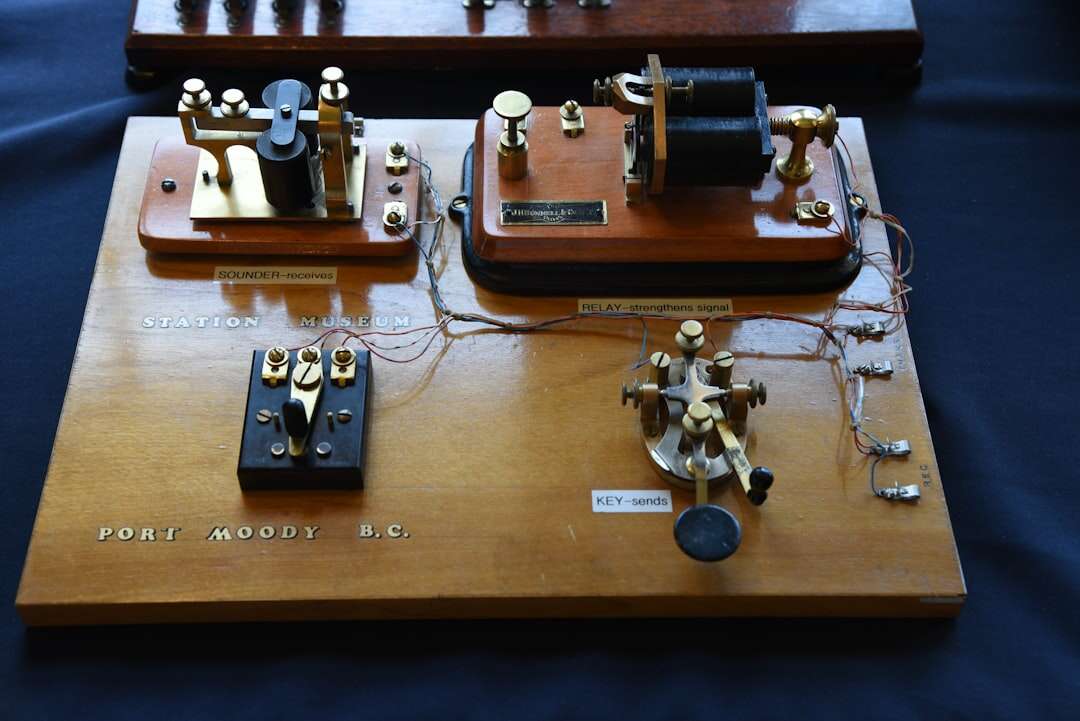
So he put the brushes down and went to work on the electromagnetic telegraph, which he demonstrated publicly in 1837.
We remember that second half. The first half is what made it possible.
My Paintings Look Nothing Like His
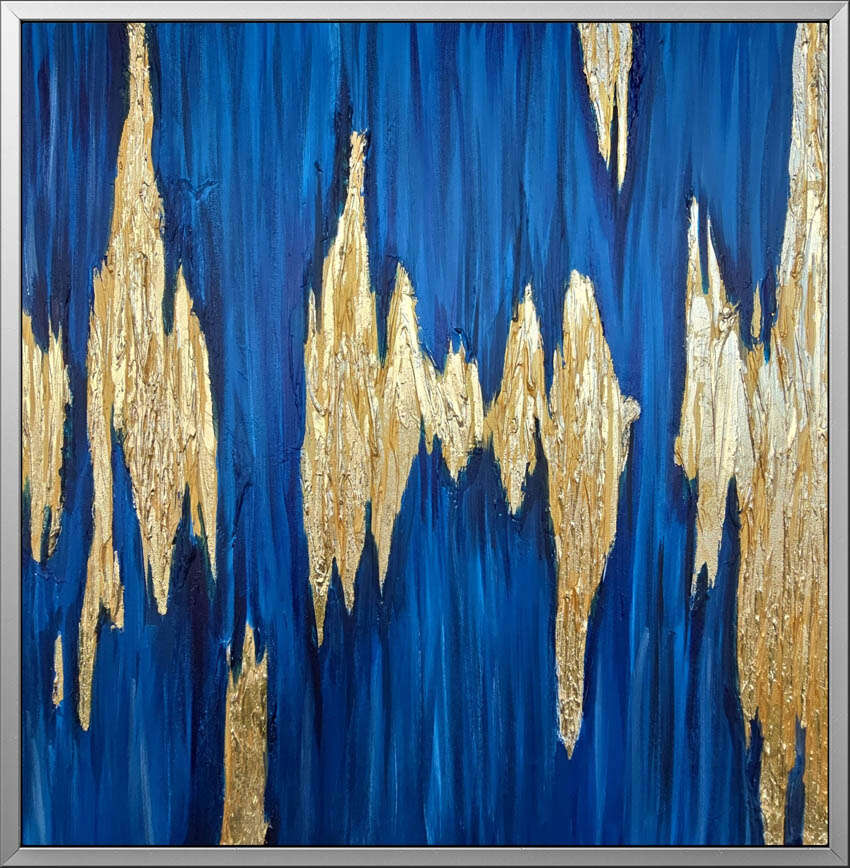
Morse painted presidents, generals and rooms full of people, and he painted them so you would know exactly who and what you were looking at. My work is abstract. I am not trying to preserve anybody’s face for posterity.
Abstract painting communicates a different way. Color, texture, depth, movement, contrast and composition do the talking. Two people can stand in front of the same canvas and come away with completely different things, and neither one of them has to be wrong.
One of my recent pieces is called Golden Frequency, and it is not a record of anything. It works through atmosphere and through the way the shapes on it relate to each other. What you get out of it is yours.
Different tools, same job. He sent a picture out into the world and hoped it landed somewhere. So do I.
Dots and Dashes, Lines and Color
Here is where the two halves of my life actually touch.
A dot means nothing. A dash means nothing. Put them in the right order with the right spacing and you get letters, call signs, grid squares and whole conversations. The meaning is not in the parts. It is in the arrangement.
A line is just a line. A patch of color is just a patch of color. Arrange them and they start pushing against each other, and out of that you get balance, tension, direction and rhythm.
Same trick, two different materials.
| What is happening | In Morse code | In a painting |
|---|---|---|
| The building block | A dot and a dash | A mark and a field of color |
| What creates the meaning | The order they come in and the spacing between them | Where things are placed and how big they are next to each other |
| What a beginner experiences | Counting individual dits and dahs and trying to keep up | Noticing individual brush marks and wondering what they add up to |
| What experience changes | You stop counting and start hearing whole characters at once | You stop cataloging parts and start seeing one composition |
| The part people underestimate | The silence between characters, which is what makes them readable | The empty space around the shapes, which is what makes them land |
| How it falls apart | Rushed or uneven spacing turns clean words into mush | A crowded canvas with nowhere to rest turns into visual noise |
Every CW operator goes through the same shift. At first you count. Dit dit dit dah. Then one day you stop counting and you just hear V. The character arrives whole and you could not break it back down into pieces if you tried. Nobody can tell you exactly when that flips. It just does.
Standing in front of a painting works the same way. Up close you see marks. Step back and the marks disappear into one thing.
If you want to feel that switch happen for yourself, that is exactly what CW Forge is built to do, and there is a longer walkthrough on learning Morse code if you are starting from zero.
Every Signal Needs Somebody on the Other End
I can hang an antenna, pick a frequency and put my call sign into the air. The second it leaves the antenna I have no idea where it goes. I do not know who hears it, how strong it lands, or whether anybody answers.
Painting is the same gamble in slower motion. You finish something, you hang it on a wall, and then you wait. Most people walk right past. Some stop. Once in a while somebody stands there long enough that you can tell it hit them, and every so often one of them takes it home.
No answer does not mean the signal was never received. Anybody who has worked a grey line opening already knows that.
That is why I bothered to mention my artwork on Ham Radio 2.0 even though we were there to talk about the book and the apps. Some of it went out into the air with everything else. You are reading this because of it.
You Do Not Have to Choose One Identity
People get sorted early. You are either the artistic one or the technical one. Creative or logical. The studio or the workshop.
I have never found that line to be real. I have built websites, taught, built furniture, cooked professionally, played instruments, written books, painted, and put a ham radio channel on YouTube. From the outside that looks scattered. From the inside it is one thing: I like making stuff, I like knowing how it works, and I like handing what I learn to somebody else.
The work is not as different as it sounds, either. A painting that is not working needs the same patience as an antenna that will not tune. You change one thing, you look at it, you change another thing. Some days the right move is to walk away and come back with clear eyes. Neither one rewards being in a hurry.
Morse was wired the same way. The observation, the hand control, the discipline of turning something in your head into an object in the world, none of that stopped being useful when he traded canvas for copper. It just found a new problem to chew on.
From the Canvas to the Airwaves
Every time you hear CW on the band, you are listening to a system invented by a professional portrait painter who had just been passed over for the job he wanted most. His paintings are still hanging on museum walls. His code is still moving through the air. Both of them are the same man trying to get something from here to there, hoping somebody on the other end was paying attention.